WizWork-Improving the Workflow of Radiation Oncologists
Facilitating Data enabled Pre-treatment Process Optimization in Radiotherapy
Graduate Thesis Project, 2023
MSc Design for Interaction, TU Delft
Duration- 6 months


A look at the design process followed for this project
Approach
Understanding Radiotherapy
What
Radiotherapy is a localized treatment used alone or alongside other treatment modalities, and utilizes ionizing radiation to address cancer and certain non-cancerous conditions.
How
External beam x-rays, electrons, protons, or gamma rays are directed towards the tumor using various methods. Machines called linear accelerators generate x-rays with precise energy levels tailored to the treatment requirements.
Why
Radiotherapy is used to preserve function and yields better cosmetic results.

PROBLEM
There are approximately 100,000 cancer patients per year in the Netherlands. This coupled with the staffing shortage leads to increasing pressure to work fast, despite the complex and meticulous nature of radiotherapy planning.

With an increasing demand to work within this complex system, there is an increasing reliance on smooth operations and uniform working methods. The roadblock at Erasmus MC right now is the unaddressed operational and working issues faced at the Radiotherapy department.
This can lead to -
delays in the start of the treatment,
losing track of the patient's status in the care pathway,
psychological stress of the professionals owing to the sense of responsibility towards the patient.
Hence the motivation for this project was to explore solutions for optimising and supporting professionals in the pre-treatment stage.
.png)
Research questions Based on Quadraple Aim
The quadruple aim is a framework for Healthcare systems and transition to population health. that pushes innovators to tackle healthcare problems sustainably, strategically, and meaningfully. The research questions were categorized under three of the four aims as seen below.
(NOTE: lead time- time between the initiation and the moment the radiotherapy is delivered to the patient.)
Since there is a lot to uncover with the last question, it was further divided into subquestions that were addressed through SEIPS 2.0 model.

CONTEXT DEEP DIVE
Throughout the length of the project I got to interact with various professionals.
These diverse interactions helped me better understand the system level and core needs of the radiation oncologists.
Research Questions
RQ: What are the different tasks being performed by the professionals during the pre-treatment process?
RQ: What are the different types of tasks of the radiation oncologist towards patient treatment planning?
RQ: What are the interdependencies that directly impact their workflow?
RQ: What are aspects of the bigger radiotherapy system that indirectly impact their workflow?


The results of the interviews and task demonstrations fall under two categories, as shown below:

RESULT 1 - SYSTEM PERSPECTIVE
-
The pre-treatment process map shows us the different steps in the pre-treatment process that occur before a patient can start their radiation sessions, starting from receiving the referral, to doing the CT scan and contouring the target tumor, defining the radiation dosage, and finally starting the first fraction.
-
Tools used reveal HIX (healthcare information system) is the unifying platform for organizing each patient case, and transferring tasks from one professional to another.
-
The happy flow describes the ideal flow and task completion per day per patient.
-
For various reasons, the happy flow gets disrupted, and instead of a smooth flow it goes back and forth between different steps, or gets stuck at different steps, and ultimately the delays can run in the weeks.
-
It must be noted that there are ideal start days for different patients based on their severity, requiring acute patients to be treated within 1 day, subacute patients within 10 calendar days, and regular patients within 28 days (The Dutch Society for Radiation Oncology ). Delays in the start of treatment can lead to negative clinical outcomes, tumor progression, and immense psychological distress.
Click the image below to zoom in

Before going into the second system level result, here's a look at the radiation oncologists tasks and goals so it is easier to relate to the system factors that affect their workflow.

SEIPS 2.0 CONFIGURATION MODEL
SEIPS 2.0 model is a human factors/ergonomics framework for studying and improving health and healthcare. It describes how sociotechnical systems shape health-related work done by professionals and non-professionals, independently and collaboratively.
Just to help you interpret this model better. the sizes of the bubbles are indicative of the level of influence that these factors have on the workflow
and the connection lines show how the factors correlate and affect each other.

Click here to expand the interactive model. Hover over the 5 different clusters to read more about a few factors in detail.
Having looked at System factors, it is paramount to understand the individual at the core of the system - The Radiation Oncologist. Here are some Guiding Principles and subsequent tensions that may lead to compromise on these principles.

The identified tensions, as discussed are a sure cause of compromise in the workflow. While the consolidated factors in
the configuration system detail the technicality of the context these tensions tie back to the core values of the radiation oncologists that leads us to better frame the emotions and the experiences that arise from these tensions. The effects and emotions are listed below.

The needs and requirements were identified by understanding what can potentially eliminate the tensions and emotional effects.
The final requirements came down to supporting oncologists through 5 ways: Reducing load with treatment plan quality checks, administrative load, task management and prioritization, peer review facilitation and knowledge of the treatment plan. Taking these into account to build a design goal to be able to use as a starting point towards the Design phase.
DESIGN GOAL

INTERACTION VISION
An interaction vision is a crucial tool in envisioning the concept's user experience, bridging the gap between abstract design goals and relatable scenarios. In this context, an interaction vision draws inspiration from a scenario akin to a head chef in a Michelin-star restaurant working alongside a sous chef to alleviate bottlenecks and disruptions, similar to how a radiation oncologist balances intricacies in treatment planning, fostering focus and meticulous planning

DATA AND INFORMATION REQUIREMENT GENERATION
The professionals were involved in this activity involving a chart, the top row listing pre-treatment steps and the first-row displaying task cards for each step, with the lower space populated by sticky notes prompted by questions like "what information is lacking in this stage?" and "how can workflow improvements be achieved"
The figure below shows the culmination of the various generated requirements for the radiation oncologists at each stage of the treatment planning process.
Click the image below to zoom in

.png)
CONCEPT FOUNDATION AND VALUE
Synthesizing the insights as requirements from the manager and RO generative sessions led to the creation of the foundation and value of the concept.

INFORMATION ARCHITECTURE
The important basis for building the concept was the information architecture that showcases the required information flow and structuring in the solution. This takes into account the important functionalities to achieve the interaction vision, as well as one step further into the utility of intelligent assistance in the necessary aspects of the solution. The 4 major clusters seen in the information architecture are : Patient overview, Tasks, Communication and Calendar.
Click the image below to zoom in
.jpg)
WIZWORK - AN OMNICHANNEL SOLUTION
Current hospital information systems typically store a lot of data in one central place. To improve how hospitals work and provide care, it's becoming more important to connect this central system with smaller, decentralized systems. These smaller systems ensure that data and services are easily available where they are needed most in the healthcare process. This helps hospitals run better and provide better care. (Musa, Yusuf, & Meckel, 2012)
Hence the final design functions as an omnichannel solution, with functionalities that extends across different mediums within the radiotherapy department. It can function as a stand-alone product as well as an extension for HiX, and both of these work in conjunction with each other to provide the professionals with a connected and cohesive solution.


SCREENS
Patient Overview


Task Logging
This new design was created to visualize an NFC task-tapping concept. Upon tapping the task card, a pop-up screen will pull up as seen in the screens below with the choice to mark a specific task as complete. Additionally, taking into account the manager's requirement to be able to understand reasons for delays, the open text field helps the oncologists to quickly fill in any possible reasons they may have experienced for the delay.

This screen is an adaptation of the familiar view of a task list, but lists the key treatment plan tasks separated from the administrative tasks. These tasks are primarily identified by the patient number, and actionable in terms of marking the task as complete once done.
The administrative tasks have the additional "wizard" assistance which is the intelligent aspect of the system that can review plans that require trivial checking. These are marked with a graphical icon indicative of the presence of intelligence to assist with the tasks.


Peer Review Requests

This screen facilitates radiation oncologists to schedule and request for peer reviews with their colleagues based on availability. It can be distinguished based on the requests made for them as well as the requests made by them. Since the professionals are quite comfortable utilizing teams for their communications, this screen shows the integration of teams to ease peer review exchanges further.
CONCEPT PART 2 - OVERLAY SCREENS
The overlay concepts are meant to serve an assistive role, with the assistant being present as a "wizard". This wizard can perform a few roles at different moments of the oncologist's tasks with HiX.
Autofill
This function helps professionals with repetitive filling-in tasks that can autofill fields that tend to have the same selections each time. The Oncologist then has the opportunity to review the filled-in information before accepting it.

Autocheck Referral
This function is meant to help radiation oncologists with the checking of the completeness of the referral received from the secretaries. The missing documents can be identified and requests can be made by the system to the triage department/ referring doctor to share the files at the earliest.

This function is meant to help radiation oncologists with the checking of the completeness of the referral received from the secretaries. The missing documents can be identified and requests can be made by the system to the triage department/ referring doctor to share the files at the earliest.
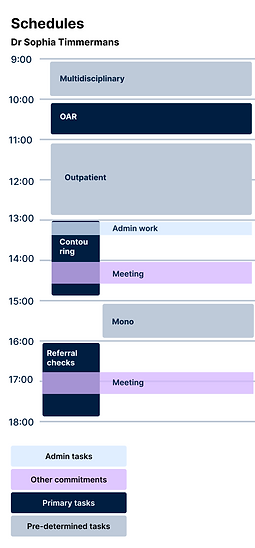
Scheduling function
Data Transactions enabled by WiZWork
Wizwork both contributes data to help address inefficiencies for the managers, as well as take data from the system in order to provide certain features. This diagram showcases the same per stage.
Click the image below to zoom in
.png)
EVALUATION
The final evaluation took place with two managers and one oncologist.
The aim of the evaluation was to test the new concept in terms of the proposed features as well as understand the usefulness of the data being captured with the help of a rating system as well as verbal feedback.
The professionals were taken through the final concept and were asked to rate specific aspects of the concept.
The final comments on the design were taken into the Recommendations.

Design recommendations
The managers felt like the scheduling concept worked well if they could be scheduled beforehand. That part can be very interesting to forecast per oncologist what the workload can be. Currently, their workloads are invisible to the managers.
They feel such a system looks promising if it can connect to HiX and work according to all systems. Works well if they would still support HiX and this would support and give much better information on the progress of the patient and workload per day, where to start, and prioritize.
When it comes to time stamps, considering HiX is progressing towards extracting the same this could change the purpose and extent of application of this concept.

